
Nitrox specialty
Certification card
Medical check
Nitrox and air
Diving equipment for nitrox
Nitrox characteristic
Prevent oxygen poisoning 1
Prevent oxygen poisoning 2
Prevent oxygen poisoning 3
Health management
Dive plans and dive table
|

|
|
Learn how to manage dive depth and dive time to reduce the risk of oxygen toxicity.
One factor that contributes to oxygen toxicity is the partial pressure of oxygen in the breathing gas.
Another factor is the total amount of oxygen absorbed by the body.
|
Dive depth management
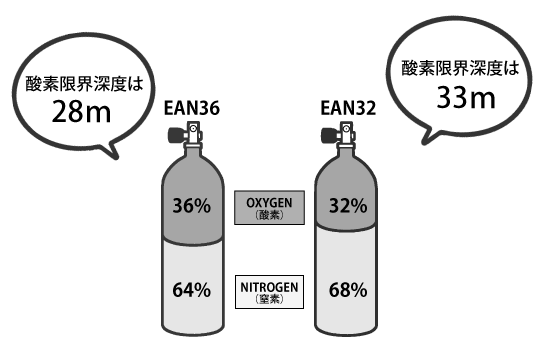
To reduce the risk of oxygen toxicity, dive depth must be limited so that the partial pressure of oxygen in the breathing gas does not exceed 1.4 atm.
Therefore, the maximum safe depth depends on the oxygen percentage of the Nitrox blend being used.
This depth is called the Maximum Operating Depth (MOD), and it can be calculated using the following formula:
MOD (round down to the nearest whole number) = (1.4 ÷ oxygen fraction − 1) × 10
For example, when using EAN32, the oxygen fraction is 0.32. Using the formula above:
MOD = (1.4 ÷ 0.32 − 1) × 10 = 33 m
When using EAN36, the oxygen fraction is 0.36. Using the same formula:
MOD = (1.4 ÷ 0.36 − 1) × 10 = 28 m
|
 |
Labeling
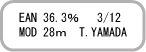
After analyzing the tank, write the measured oxygen percentage and the calculated MOD on a piece of duct tape and attach it to the cylinder.
For example, if the analyzed oxygen percentage is 36.3%, the analysis date is March 12, the calculated MOD is 28 m, and the analyzer’s name is Taro Yamada, record this information clearly on the label.
|
 |
|
|


|
|
