|
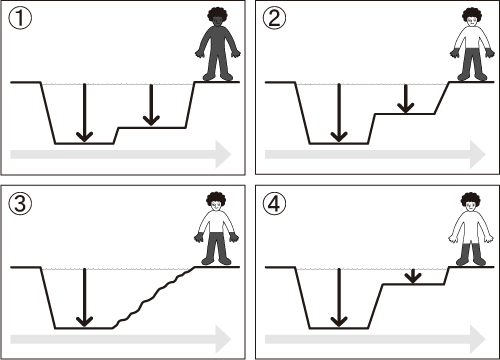
The four illustrations below show different ascent profiles and the corresponding nitrogen loading for each dive.
Traditional dive tables assume a continuous ascent rate of approximately 10 meters per minute and are primarily based on maximum depth and total bottom time.
However, profiles that include extended time at shallower depths during ascent — such as multilevel dives — are not specifically accounted for in conventional dive table calculations.
Because the exact nitrogen levels in a diver’s body cannot be directly measured after a dive, dive tables conservatively include shallow time during ascent as part of the total dive time when determining the Residual Nitrogen Group.
Although dive tables may classify the profiles shown below as equivalent dives, the actual nitrogen accumulation differs depending on the depth pattern and ascent behavior.
This difference highlights the importance of understanding ascent profiles and using a dive computer for more precise nitrogen tracking.
|