目次

Let's appeal you are diver in town!

Certification card

Relationship between dive profile and nitrogen accumulation during descent

Relationship between dive profile and nitrogen accumulation during ascent

Leisure diving and dive table

Leisure diving and dive computer

How the dive computer works 1

How the dive computer works 2

How the dive computer works 3

Make a dive plan

Dive computer display 1

Dive computer display 2

Precautions for use

Emergency response


■ Descent and Nitrogen Absorption

When a diver begins to descend, nitrogen dissolves into the body tissues at a rapid rate due to the increase in ambient pressure.

As time passes, the rate of nitrogen absorption gradually slows. Eventually, a state is reached where no additional nitrogen is absorbed. This condition is called tissue saturation.


■ Ascent and Nitrogen Elimination

When ascent begins and ambient pressure decreases, dissolved nitrogen starts to be eliminated from the body.

The rate of nitrogen elimination is initially faster and then gradually decreases over time. After sufficient time has passed, no further nitrogen is released because the tissue has returned to equilibrium with surface pressure.


■ Nitrogen Saturation and Tissue Compartments

The state in which nitrogen is neither being absorbed nor eliminated is called saturation.

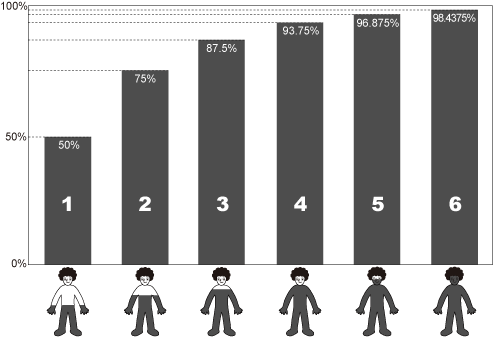
The time required for a tissue to reach practical saturation is approximately six times its half-time. A half-time is the time required for a tissue to absorb or release 50% of the difference between its current nitrogen level and its equilibrium level.

Different body tissues absorb and release nitrogen at different rates. For example, blood — with a half-time of approximately 5 minutes — reaches near saturation in about 30 minutes, while fatty tissues — with a half-time of about 720 minutes — may require up to 72 hours.

Modern dive computer algorithms divide the body into multiple theoretical tissue compartments, each with different half-times, typically ranging from about 5 minutes to 72 hours. These compartments simulate how nitrogen moves through the body during a dive.


BACK   NEXT

© net-diver school.2006.All rights reserved