
Deep diving specialty
Certification card
Equipment 1
Equipment 2
Equipment 3
Equipment 4
Prevention for decompression sickness 1
Prevention for decompression sickness 2
Prevention for decompression sickness 3
Symptoms of decompression sickness
Treatment for decompression sickness
Prevention for Nitrogen Narcosis
Treatment for Nitrogen Narcosis
Plans and rules
Changes in air consumption rate
Calculation of dive time limit
Depth limit
Boat support
Diving preparation
Descent
Underwater action
Ascent and exit
Emergency action
|

|
|
Air consumption rate (often called Surface Air Consumption, or SAC) is the amount of air you use per minute at the surface (on land-equivalent conditions).
When your air consumption rate increases, you will use the air in your cylinder more quickly.
|
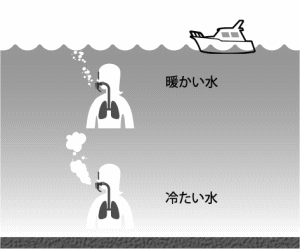
*Cold water can increase your air consumption rate. |
|
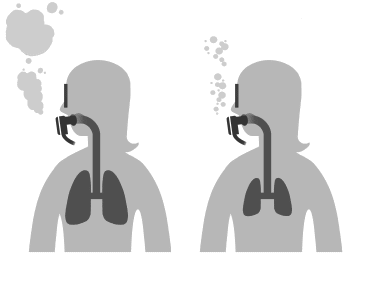
*Divers with larger lung volume may have higher air consumption than those with smaller lung volume. |
 |
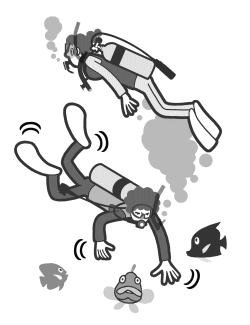
*Higher workload (more swimming or exertion) increases air consumption. |
 |
*Stress or anxiety can increase air consumption.
*Less experienced divers often consume more air than more experienced divers.
|
|
|
|
You can calculate your air consumption rate using the following steps.
In this example, volume is in liters, pressure is in atm, and time is in minutes.
|
|
|
1.Start pressure - End pressure = Pressure used
2.Pressure used × Cylinder capacity = Gas used
3.Gas used ÷ Time = Air consumption rate
|
|
|
◆◇◆ Question ◆◇◆
I used a 12-liter cylinder filled to 200 atm and swam at a steady pace at the surface for 10 minutes.
After swimming, the remaining pressure was 175 atm.
What is the air consumption rate in this case?
|
|
|
◆◇◆ Answer ◆◇◆
The air consumption rate is 30 liters per minute. Using the formula above:
1.200 atm (Start pressure) - 175 atm (End pressure) = 25 atm (Pressure used)
2.25 atm (Pressure used) × 12 liters (Cylinder capacity) = 300 liters (Gas used)
3.300 liters (Gas used) ÷ 10 minutes (Time) = 30 liters/min (Air consumption rate)
|
|
|
  |
|
