|
The training procedures defined by STARS adopt a step-by-step teaching method.
This method means progressing instruction from what students can do to what they cannot yet do.
For example, after mastering mask clearing, students proceed to mask removal and replacement. The STARS training procedures are designed so that more difficult skills (such as surface swimming without a mask) and complex procedures (such as mask removal and replacement) are broken down into smaller, teachable components.
Therefore, each section has its own objectives, and students must achieve the objectives of each section before progressing to the next.
Each section consists of “Motivation → Explanation → Demonstration → Practice → Evaluation.”
【Motivation】
Motivate students by explaining the necessity of the knowledge and skills they need to master.
【Explanation】
Explain posture and procedures during practice while emphasizing key points.
Avoid lengthy explanations and focus on clear, concise key points to prevent misunderstandings.
【Demonstration】
Demonstrations should be conducted on the surface or in shallow water where students can stand, so they are easy to understand.
Explain whether students should observe the demonstration above or below the surface.
If observing underwater, explain whether to breathe using a snorkel or a regulator.
Use exaggerated gestures to show both correct and incorrect examples.
By coordinating with assistants in advance, the instructor can explain procedures while assistants demonstrate, making techniques easier to understand.
【Practice】
Explain who will practice, where, and how many times. When swimming, explain the route, distance, and course clearly.
In pools where longer distances are possible, it is difficult to correct mistakes mid-way, so start with shorter distances and gradually increase once skills are established.
Once students begin a swim course, instructions become difficult to communicate until they return, so clear explanations of distance, route, repetitions, and practice points are essential.
Except in shallow water where students can stand chest-deep, do not have more than one student practice simultaneously.
Always stay close enough to assist immediately or maintain physical contact when guiding students.
If a student cannot perform a skill well, explain the reason and how to improve.
【Evaluation】
A skill is considered achieved when the student successfully meets the objective twice consecutively and can perform it confidently when asked verbally.
Evaluate students individually, not all at once.
Only proceed to the next section after all objectives in the current section have been achieved.
Only students who complete all section objectives can finish the course and advance to the next level.
For middle-aged and older students, it is also possible to divide the procedures into smaller sections and proceed more slowly with additional time.
|
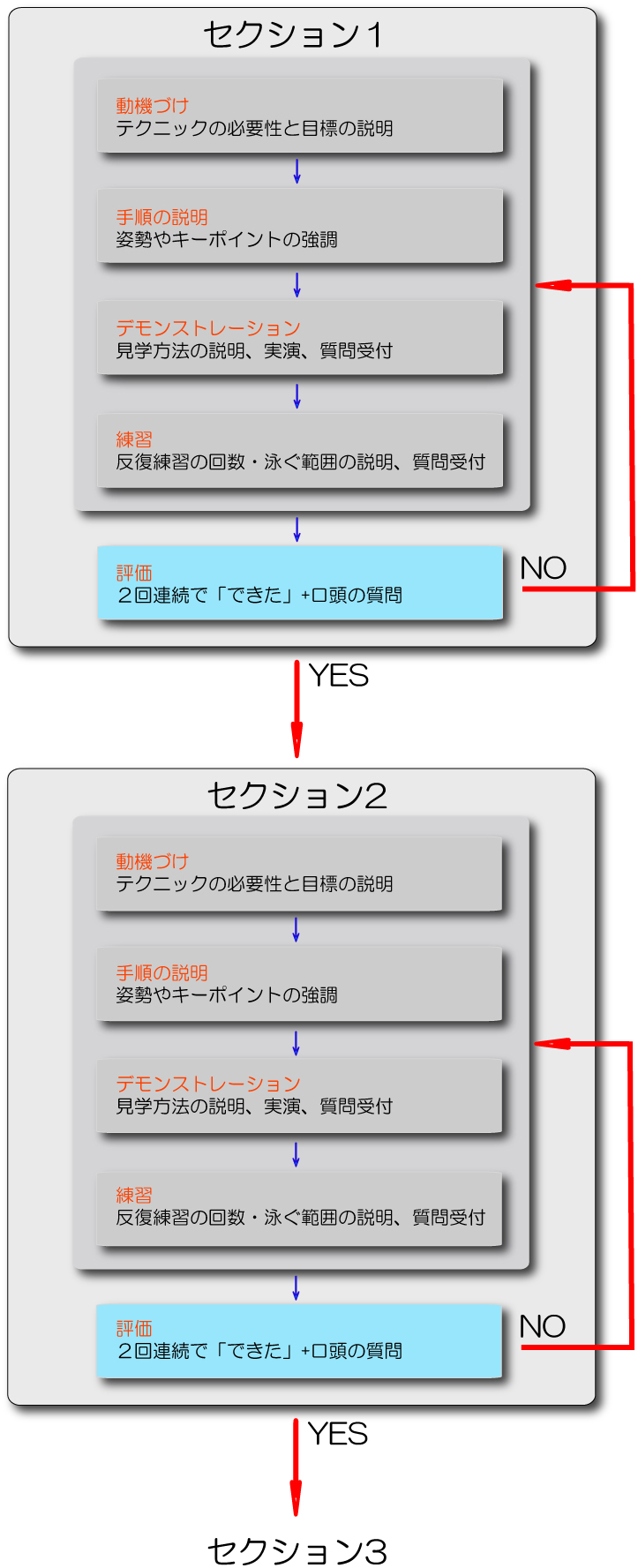
Flow of the step-by-step teaching method
|





