目次

Holiday Complete Healing

Certification card

Self rescue equipment

Self rescue technique1

Self rescue technique2

Self rescue technique3

Self rescue technique4

Self rescue technique5

Self rescue technique6

Diver stress1

Diver stress2

Buddy stress response1

Buddy stress response2

Assist rescue equipment

Assist rescue technique1

Assist rescue technique2

Assist rescue technique3

Assist rescue technique4

Assist rescue technique5


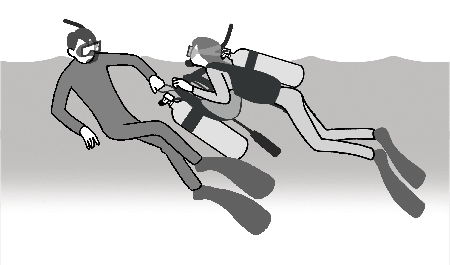
When assisting a diver in difficulty at the surface, provide clear instructions and establish positive buoyancy.

Maintain a safe distance during the approach and control the situation to prevent escalation.

Effective assistance requires the diver’s cooperation. Use simple, direct commands and verify understanding.

■ BCD Rescue (Surface Assistance)

  1. Approach the diver from the front while maintaining a controlled distance.
    A distressed diver may panic and attempt to grab you. Stop just outside arm’s reach and assess the diver’s condition.
  2. Establish your own flotation and maintain airway protection.
    If needed, secure your snorkel or regulator and confirm stable buoyancy.
  3. If appropriate, release the diver’s weights to reduce negative buoyancy.
    Use standard weight-release procedures and avoid entanglement.
  4. Remove your BCD only if conditions allow and you can maintain control.
    Inflate the BCD fully to create a stable flotation device.
  5. Give a clear instruction to the diver to take the BCD.
    Present the inflated BCD and maintain physical control of the unit while the diver makes contact.
  6. Instruct the diver to hold the BCD securely and establish calm, controlled breathing.
    Pause until the diver demonstrates stable breathing and reduced anxiety.
  7. Maintain control of the BCD and tow the diver to a safe location while monitoring condition and breathing.


BACK  NEXT

© net-diver school.2006.All rights reserved